Percentage Difference vs. Percentage Change: What's the Difference?
Percentage difference and percentage change are not the same thing. Learn when to use each formula, see worked examples, and avoid the most common mistake.
- percentage difference
- percentage change
- comparison
- formula
- math concepts

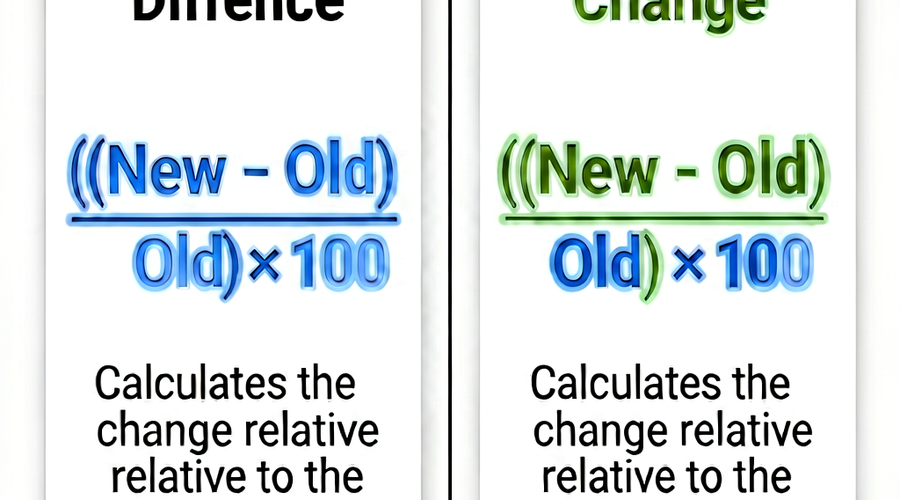
These two terms sound almost identical, and many people use them interchangeably. They should not — they measure different things, use different formulas, and give different answers from the same pair of numbers.
Understanding the distinction prevents genuine errors in analysis, reporting, and everyday reasoning.
The core distinction
| Term | Question it answers | Has direction? | Formula |
|---|---|---|---|
| Percentage change | How much did this value change relative to a starting point? | Yes (increase or decrease) | ((New − Old) / Old) × 100 |
| Percentage difference | How different are these two values relative to their average? | No | (|V1 − V2| / ((V1 + V2) / 2)) × 100 |
The key insight:
- Percentage change has a clear “before” and “after” — a time sequence, or a reference and a comparison. The old value is the denominator.
- Percentage difference treats both values symmetrically — neither one is the reference. The average of the two values is the denominator.
Percentage change: formula and examples
Use percentage change when one value clearly comes before or is the baseline for the other.
Percentage Change = ((New Value − Old Value) / Old Value) × 100Example 1 — Price over time
A product cost $80 in January and costs $96 in June.
((96 − 80) / 80) × 100 = (16 / 80) × 100 = +20%The price increased by 20% relative to January.
Example 2 — Year-on-year revenue
Revenue was $1.2M last year and is $1.08M this year.
((1.08 − 1.20) / 1.20) × 100 = (−0.12 / 1.20) × 100 = −10%Revenue decreased by 10%.
The direction (positive/negative) matters here because January and last year are the defined baselines.
Percentage difference: formula and examples
Use percentage difference when you are comparing two values without a clear baseline — two measurements at the same time, two competing options, two data points from different sources.
Percentage Difference = (|V1 − V2| / ((V1 + V2) / 2)) × 100The denominator is the average (mean) of the two values, sometimes called the “midpoint” or “reference value.”
Example 1 — Two stores’ prices
Store A sells the same item for $45; Store B sells it for $55. What is the percentage difference in price?
|45 − 55| = 10
Average = (45 + 55) / 2 = 50
Percentage Difference = (10 / 50) × 100 = 20%
The prices differ by 20% (using the average price as the reference).
Example 2 — Two lab measurements
Two technicians measured the same chemical sample: Technician A recorded 8.4 g and Technician B recorded 9.2 g. What is the percentage difference between the measurements?
|8.4 − 9.2| = 0.8
Average = (8.4 + 9.2) / 2 = 8.8
Percentage Difference = (0.8 / 8.8) × 100 = 9.09%
The measurements differ by approximately 9.1%. Neither measurement is treated as the “correct” reference — both are equally uncertain.
Why percentage difference uses the average as the denominator
This is the question most people ask. The reason comes down to symmetry.
Suppose you compare $45 and $55 using percentage change:
- From $45 perspective:
((55 − 45) / 45) × 100 = 22.2% - From $55 perspective:
((45 − 55) / 55) × 100 = −18.2%
The same price gap gives you completely different percentages depending on which number you put in the denominator. That asymmetry is fine when one value is a true baseline (that is percentage change), but it is a problem when both values are equally valid.
Using the average as the denominator gives a single, symmetric answer: 20%.
Side-by-side comparison with the same numbers
Take two values: 100 and 130.
| Calculation | Formula | Result |
|---|---|---|
| % change from 100 to 130 | ((130 − 100) / 100) × 100 | +30% |
| % change from 130 to 100 | ((100 − 130) / 130) × 100 | −23.1% |
| % difference between 100 and 130 | (30 / 115) × 100 | 26.1% |
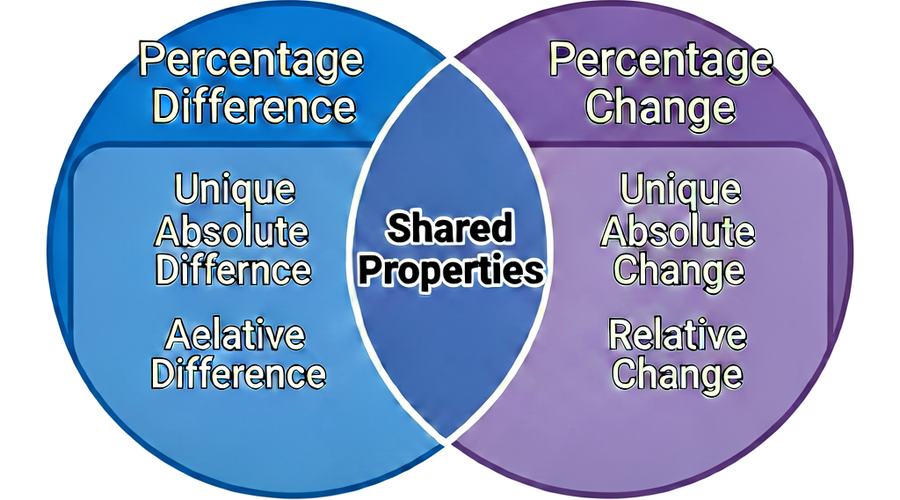
Three different numbers from the same pair of values — because each formula asks a different question.
When to use each
Use percentage change when:
- You are tracking something over time (prices, sales, weight, temperature)
- You have a clear “before” and “after”
- You are measuring performance against a target or benchmark
- Direction matters (you want to know if it went up or down)
Use percentage difference when:
- You are comparing two simultaneous measurements
- Neither value is the “original” or “reference”
- You want a symmetric comparison (the order of V1 and V2 should not matter)
- You are reporting measurement error or variability between two instruments or observers
A note on percentage points
There is a third related concept worth keeping clear: percentage points.
Percentage points are used when both values are already expressed as percentages.
- An unemployment rate changing from 5% to 7% is an increase of 2 percentage points.
- As a percentage change:
((7 − 5) / 5) × 100 = 40%— a 40% increase in the rate itself.
Confusing these is extremely common in media reporting. “The interest rate rose 2%” and “the interest rate rose 2 percentage points” describe completely different moves.
Common mistakes
Mistake 1 — Using percentage change for symmetric comparisons.
If you are comparing the price at two stores and neither is the “original,” using (A − B) / B privileges store B unfairly. Use the average as the denominator.
Mistake 2 — Using percentage difference for time-series data. If sales grew from Q1 to Q2, percentage difference gives a misleading result. You have a clear baseline (Q1), so use percentage change.
Mistake 3 — Saying “percentage change” when you mean “percentage points.” If a tax rate went from 20% to 25%, it increased by 5 percentage points, or by 25% as a percentage change. Be explicit.
Calculate either instantly
Both formulas are straightforward once you identify which applies. Our percentage calculator handles both percentage change and percentage difference — enter your two values and let it decide the arithmetic.
Related reading
-
Percentage Change Formula: How to Calculate Increase and Decrease
Master the percentage change formula for both increases and decreases. Includes step-by-step examples, a quick reference table, and common pitfalls.
-
What Percentage Is X of Y? The Simple Formula Explained
Learn the one formula that answers 'what percentage is X of Y?' — with worked examples, a reference table, and tips for getting it right every time.