What Percentage Is X of Y? The Simple Formula Explained
Learn the one formula that answers 'what percentage is X of Y?' — with worked examples, a reference table, and tips for getting it right every time.
- percentage
- what percentage is x of y
- formula
- math basics
- percentage of total

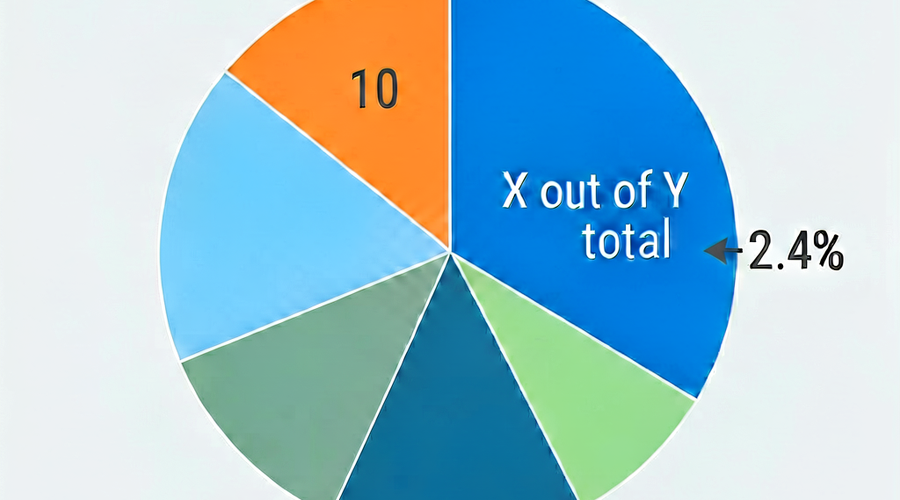
“What percentage is 30 of 120?” “My team hit 47 out of 60 targets — what percentage is that?” Questions like these come up constantly in school, work, and everyday life. The answer always comes from the same single formula.
The formula
Percentage = (X / Y) × 100Where:
- X is the part (the number you want to express as a percentage)
- Y is the whole (the total, the base, the reference number)
That is the complete formula. Everything else in this guide is just applying it to different real-world scenarios.
How to use it — step by step
- Write down X (the part) and Y (the whole).
- Divide X by Y.
- Multiply the result by 100.
- Add the % symbol.
Example: What percentage is 30 of 120?
Step 1: X = 30, Y = 120
Step 2: 30 ÷ 120 = 0.25
Step 3: 0.25 × 100 = 25
Step 4: 25%
30 is 25% of 120.
Identifying X and Y in word problems
The trickiest part of these problems is usually figuring out which number is X and which is Y. Here is a reliable rule of thumb:
- The number after “of” is almost always Y (the whole).
- The number before “is” or “out of” is almost always X (the part).
| Question phrasing | X (part) | Y (whole) |
|---|---|---|
| “What percentage is 18 of 90?“ | 18 | 90 |
| ”15 out of 60 — what percentage?“ | 15 | 60 |
| ”She scored 44 of 55 points” | 44 | 55 |
| ”12 of the 80 items were defective” | 12 | 80 |
| ”You have completed 3 of 8 tasks” | 3 | 8 |
Worked examples
Example 1 — Test score
A student got 38 questions right out of 50. What percentage did they score?
(38 / 50) × 100 = 76%Example 2 — Budget used
A project had a $24,000 budget. The team spent $18,600. What percentage of the budget was used?
(18,600 / 24,000) × 100 = 77.5%Example 3 — Defect rate
A factory produced 1,200 units. Quality control flagged 36 as defective. What is the defect rate?
(36 / 1,200) × 100 = 3%Example 4 — Survey response
120 people were surveyed. 84 said they preferred the new design. What percentage preferred the new design?
(84 / 120) × 100 = 70%Example 5 — Attendance
A class has 32 students. 28 attended today. What is the attendance percentage?
(28 / 32) × 100 = 87.5%Quick reference: common fractions as percentages
You will encounter these fractions constantly. Memorising them saves time.
| Fraction | Decimal | Percentage |
|---|---|---|
| 1/2 | 0.5 | 50% |
| 1/3 | 0.333… | 33.3% |
| 2/3 | 0.667… | 66.7% |
| 1/4 | 0.25 | 25% |
| 3/4 | 0.75 | 75% |
| 1/5 | 0.2 | 20% |
| 2/5 | 0.4 | 40% |
| 3/5 | 0.6 | 60% |
| 4/5 | 0.8 | 80% |
| 1/8 | 0.125 | 12.5% |
| 3/8 | 0.375 | 37.5% |
| 5/8 | 0.625 | 62.5% |
| 7/8 | 0.875 | 87.5% |
| 1/10 | 0.1 | 10% |
| 1/20 | 0.05 | 5% |
When the result is over 100%
X can be larger than Y. If you produced 130 units against a target of 100, the calculation is:
(130 / 100) × 100 = 130%A result over 100% simply means X exceeds Y. You exceeded target by 30%. This is perfectly valid and common in goal-tracking contexts.
When the result is a decimal percentage
Sometimes the answer is not a clean number:
(17 / 24) × 100 = 70.833...%Round to whatever precision makes sense for your context:
- For a classroom: 70.8%
- For a quick estimate: 71%
- For a financial report: 70.83%
Do all your division and multiplication first, then round only the final result.
The two related questions
Once you know (X / Y) × 100, you can solve the two related question types too:
Find X when you know the percentage and Y:
X = (Percentage / 100) × Y“What is 25% of 120?” → (25/100) × 120 = 30
Find Y when you know the percentage and X:
Y = X / (Percentage / 100)“30 is 25% of what number?” → 30 / 0.25 = 120
All three problems are the same triangle of numbers: X, Y, and the percentage. Know any two, solve for the third.
Try it yourself
The formula is simple, but entering the wrong number in the wrong slot is easy when you are working quickly. Our percentage calculator lets you type in X and Y and get the answer instantly — it also works backwards if you need to find the part or the whole.
Related reading
-
How to Calculate Percentage: Formula, Examples, and Shortcuts
Learn how to calculate percentage with the core formula, step-by-step examples, and mental-math shortcuts you can use anywhere.
-
How to Work Out Percentages Without a Calculator
Master mental math strategies for working out percentages without a calculator — from the 10% building-block method to fraction shortcuts and estimation tricks.
-
Percentage Difference vs. Percentage Change: What's the Difference?
Percentage difference and percentage change are not the same thing. Learn when to use each formula, see worked examples, and avoid the most common mistake.