How to Calculate Percentage: Formula, Examples, and Shortcuts
Learn how to calculate percentage with the core formula, step-by-step examples, and mental-math shortcuts you can use anywhere.
- percentage
- how-to
- math basics
- percentage formula
- percentage calculator
Percentages are everywhere — sale prices, test scores, nutrition labels, tax rates, investment returns. Despite that, many people reach for their phone to do percentage math because the formula never quite stuck. This guide will change that.
By the end you will understand the core formula, know how to flip it for different scenarios, and have a handful of shortcuts that make percentage math fast even without a calculator.
The core percentage formula
A percentage is just a fraction with a denominator of 100. “Per cent” literally means “per hundred.” The foundational formula is:
Percentage = (Part / Whole) × 100Example: You scored 42 out of 50 on a quiz. What percentage did you get?
Percentage = (42 / 50) × 100 = 84%That is it. Every other percentage calculation is a rearrangement of this single relationship.
The three percentage problems (and how to solve each)
There are really only three types of percentage questions. Once you recognise which type you are looking at, you know exactly which version of the formula to use.
| Problem type | What you know | What you find | Formula |
|---|---|---|---|
| Type 1 — Find the percentage | Part and Whole | Percentage | (Part / Whole) × 100 |
| Type 2 — Find the part | Percentage and Whole | Part | (Percentage / 100) × Whole |
| Type 3 — Find the whole | Percentage and Part | Whole | Part / (Percentage / 100) |
Type 1: What percentage is 15 of 60?
(15 / 60) × 100 = 25%Type 2: What is 30% of 80?
(30 / 100) × 80 = 0.30 × 80 = 24Type 3: 18 is 45% of what number?
18 / (45 / 100) = 18 / 0.45 = 40Step-by-step worked examples
Example 1 — Exam score
A student answered 37 out of 40 questions correctly. What is their percentage score?
- Identify the Part: 37
- Identify the Whole: 40
- Apply:
(37 / 40) × 100 = 92.5%
Example 2 — Sales commission
A salesperson earned a $1,200 commission on a $15,000 sale. What commission rate did they receive?
- Part = $1,200, Whole = $15,000
(1200 / 15000) × 100 = 8%
Example 3 — Budget spending
A household budgets $2,500 per month and wants to spend 15% on groceries. How much is that?
- Percentage = 15, Whole = $2,500
(15 / 100) × 2500 = $375
Example 4 — Working backwards
A dress is on sale. The discount is $24, which represents 20% of the original price. What was the original price?
- Part = $24, Percentage = 20%
24 / (20 / 100) = 24 / 0.20 = $120
Mental math shortcuts for common percentages
You do not always need a calculator. These shortcuts let you estimate percentages quickly in your head:
10%: Move the decimal point one place to the left.
- 10% of 350 = 35
5%: Find 10%, then halve it.
- 5% of 350 = 35 ÷ 2 = 17.5
1%: Move the decimal point two places to the left.
- 1% of 350 = 3.5
25%: Divide by 4.
- 25% of 80 = 20
50%: Divide by 2.
- 50% of 140 = 70
20%: Find 10% and double it.
- 20% of 65 = 6.5 × 2 = 13
75%: Find 25% and multiply by 3 (or find 50% + 25%).
- 75% of 80 = 20 × 3 = 60
Building from parts: For awkward percentages like 35%, break them up.
- 35% = 25% + 10%
- 35% of 200 = 50 + 20 = 70
Percentage vs. percentage points
This is a common source of confusion. Suppose an interest rate rises from 4% to 6%.
- The percentage point increase is 2 (you just subtract: 6 − 4 = 2 percentage points).
- The percentage change in the rate itself is 50% (
(2 / 4) × 100 = 50%).
Journalists and politicians routinely mix these up. When someone says “rates rose by 2%,” they almost always mean 2 percentage points, not a 2% increase in the rate. Always check which one is being used.
Rounding percentages correctly
When a percentage calculation produces a long decimal — say, 33.333…% — rounding rules matter:
- For general communication: Round to one decimal place (
33.3%) unless precision is critical. - For financial or scientific work: Follow the precision convention of your field (often two decimal places).
- For whole-number percentages: Round normally — 0.5 rounds up, anything below 0.5 rounds down.
Avoid rounding intermediate steps. Finish the full calculation, then round only the final answer.
Common mistakes to avoid
Mistake 1 — Dividing the wrong way. Always divide the Part by the Whole, not the other way around. Dividing 50 by 42 gives you 119%, not 84%.
Mistake 2 — Forgetting to multiply by 100. The formula gives you a decimal (0.84). Multiplying by 100 converts it to a percentage (84%).
Mistake 3 — Confusing percentage points and percentages. Covered above — keep them separate.
Mistake 4 — Adding percentages of different wholes. You cannot average raw percentages unless the sample sizes are equal. A class with 80% pass rate and another with 70% pass rate does not automatically give a 75% combined pass rate — you need to know how many students are in each class.
Quick reference table
| % | Decimal | Fraction | Shortcut |
|---|---|---|---|
| 10% | 0.10 | 1/10 | ÷ 10 |
| 20% | 0.20 | 1/5 | ÷ 10, × 2 |
| 25% | 0.25 | 1/4 | ÷ 4 |
| 33.3% | 0.333 | 1/3 | ÷ 3 |
| 50% | 0.50 | 1/2 | ÷ 2 |
| 66.7% | 0.667 | 2/3 | ÷ 3, × 2 |
| 75% | 0.75 | 3/4 | ÷ 4, × 3 |
| 100% | 1.00 | 1/1 | — |
Calculate percentages instantly
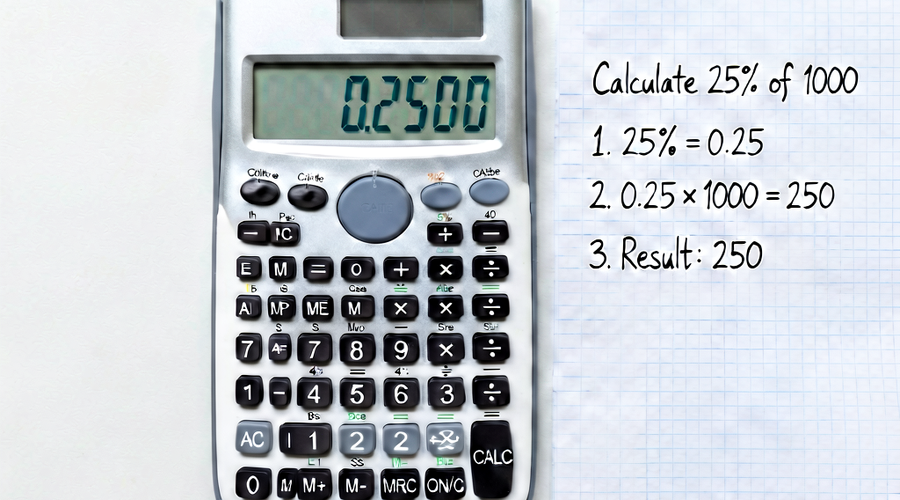
You now have the formula, the three problem types, and the shortcuts. For calculations where speed matters more than mental gymnastics, use our percentage calculator. It handles all three problem types, percentage change, discounts, and more — no formula memorisation required.
Related reading
-
How to Work Out Percentages Without a Calculator
Master mental math strategies for working out percentages without a calculator — from the 10% building-block method to fraction shortcuts and estimation tricks.
-
What Percentage Is X of Y? The Simple Formula Explained
Learn the one formula that answers 'what percentage is X of Y?' — with worked examples, a reference table, and tips for getting it right every time.
-
How to Calculate a Discount Percentage (and the Final Price)
Learn how to calculate discount percentages and final sale prices with step-by-step formulas, worked examples, and a quick reference for common discounts.