How to Work Out Percentages Without a Calculator
Master mental math strategies for working out percentages without a calculator — from the 10% building-block method to fraction shortcuts and estimation tricks.
- mental math
- percentage
- no calculator
- percentage shortcuts
- how-to
Your phone is dead. You are standing at a market stall trying to figure out if a 35% discount on a $68 item is worth it. Or you are in a meeting and someone asks what percentage of budget has been spent. No calculator in sight.
These situations come up more often than you think, and the good news is that mental percentage math is a learnable skill. You do not need to be a maths genius — you just need a few reliable strategies.
Strategy 1: The 10% building block
The most powerful single trick for mental percentage math is this:
10% of any number = move the decimal point one place to the left.
- 10% of 80 = 8
- 10% of 350 = 35
- 10% of 4,200 = 420
- 10% of 6.50 = 0.65
Once you have 10%, you can build almost any percentage by multiplying and adding.
| Percentage | Method | Example (base = 80) |
|---|---|---|
| 10% | Decimal left one place | 8 |
| 20% | 10% × 2 | 16 |
| 30% | 10% × 3 | 24 |
| 5% | 10% ÷ 2 | 4 |
| 15% | 10% + 5% | 8 + 4 = 12 |
| 25% | 10% × 2 + 5% | 16 + 4 = 20 |
| 35% | 10% × 3 + 5% | 24 + 4 = 28 |
| 1% | Decimal left two places | 0.8 |
| 11% | 10% + 1% | 8 + 0.8 = 8.8 |
Worked example: 35% of $68
- 10% of 68 = 6.80
- 30% = 6.80 × 3 = 20.40
- 5% = 6.80 ÷ 2 = 3.40
- 35% = 20.40 + 3.40 = $23.80
So the discount is $23.80 and the final price is $68 − $23.80 = $44.20.
Strategy 2: Fraction equivalents
Certain percentages are just familiar fractions. Memorise these and you can skip the building-block process entirely for these common values:
| Percentage | Fraction | How to calculate |
|---|---|---|
| 50% | 1/2 | Divide by 2 |
| 25% | 1/4 | Divide by 4 |
| 75% | 3/4 | Divide by 4, multiply by 3 |
| 20% | 1/5 | Divide by 5 |
| 10% | 1/10 | Divide by 10 |
| 33.3% | 1/3 | Divide by 3 |
| 66.7% | 2/3 | Divide by 3, multiply by 2 |
| 12.5% | 1/8 | Divide by 8 |
| 40% | 2/5 | Divide by 5, multiply by 2 |
| 60% | 3/5 | Divide by 5, multiply by 3 |
Worked examples using fractions
25% of 64: Divide by 4 → 16
20% of 85: Divide by 5 → 17
75% of 120: Divide by 4 = 30; multiply by 3 = 90
33% of 99: Divide by 3 → 33 (and 33 × 3 = 99, so this confirms it)
Strategy 3: Flip the percentages
Here is a surprising rule that many people never learn:
X% of Y = Y% of X
This means that if the original calculation looks hard, you can swap the numbers:
-
4% of 75 looks hard.
-
75% of 4 is easy: 75% of 4 = 3. So 4% of 75 = 3.
-
8% of 50 looks tricky.
-
50% of 8 = 4. So 8% of 50 = 4.
-
16% of 25: 25% of 16 = 4. So 16% of 25 = 4.
This works best when swapping gives you a percentage from the fraction table above (like 25%, 50%, 75%) combined with a small, easy number.
Strategy 4: Estimation by rounding
Sometimes you do not need an exact answer — you need a fast sanity check. Round to the nearest “friendly” number first, calculate, then adjust.
Example: 18% of 53
- Round 53 to 50 (close enough)
- 18% ≈ 20% for estimation
- 20% of 50 = 10
- The actual answer is slightly less than 10 (since 18 < 20 and 53 > 50, these adjustments partially cancel)
- Exact answer: 9.54 — your estimate of ~10 is perfectly useful for most contexts
For tipping at a restaurant, this level of precision is more than adequate.
Strategy 5: The reverse approach for “what percentage”
You often need to figure out what percentage one number is of another — for example, after a quiz. The mental approach:
- Set up the fraction: Part over Whole.
- Simplify the fraction if possible.
- Convert to a percentage you recognise.
Example: 15 out of 20
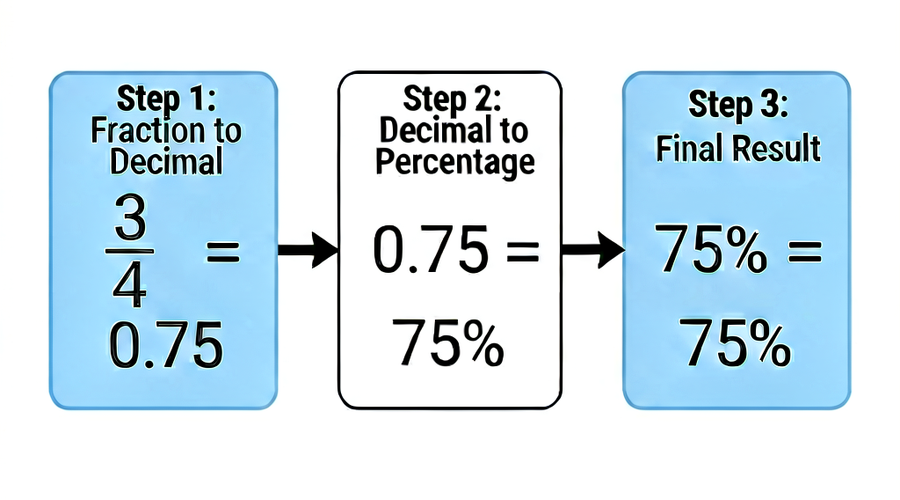
- Fraction: 15/20
- Simplify: 3/4
- 3/4 = 75%
Example: 24 out of 40
- Fraction: 24/40
- Simplify: 3/5
- 3/5 = 60%
Example: 36 out of 48
- Fraction: 36/48
- Simplify: 3/4
- 3/4 = 75%
If simplifying gives you a fraction from the table above, you are done. If not, reach for the 10% method.
Strategy 6: Benchmark and adjust
For percentages that do not simplify cleanly, find the nearest benchmark and adjust:
Example: 23% of 80
- 20% of 80 = 16 (that’s 10% doubled)
- 3% of 80 = 2.4 (that’s 1% tripled, and 1% of 80 = 0.8)
- 23% = 16 + 2.4 = 18.4
Example: 47% of 200
- 50% of 200 = 100
- 47% = 50% minus 3%
- 3% of 200 = 6
- 47% = 100 − 6 = 94
Going up to a round number and subtracting is often faster than building up from scratch.
Putting it all together: a real-world drill
You are splitting a restaurant bill. The total is $92. You want to leave an 18% tip.
Method:
- 10% of 92 = $9.20
- 5% = $9.20 ÷ 2 = $4.60
- 3% = roughly 3 × $0.92 = $2.76 (or about $2.75)
- 18% = 10% + 5% + 3% = $9.20 + $4.60 + $2.76 = $16.56
Round to $17 and nobody at the table will complain.
Summary of all strategies
| Strategy | Best for |
|---|---|
| 10% building block | Any percentage, universally applicable |
| Fraction equivalents | 25%, 50%, 75%, 20%, 33%, 66% |
| Flip X% of Y = Y% of X | When swapping makes the calculation easier |
| Estimation by rounding | Quick sanity checks, tips, informal estimates |
| Fraction simplification | ”What percentage is X of Y” questions |
| Benchmark and adjust | Percentages near a round number like 25, 50, 75 |
When to use a calculator anyway
Mental math is fast for estimates and common percentages. But for precise figures — tax calculations, payroll, financial reporting — use a proper tool. Our percentage calculator handles exact calculations instantly, so you can verify your mental estimates or tackle the cases where precision actually matters.
Related reading
-
How to Calculate Percentage: Formula, Examples, and Shortcuts
Learn how to calculate percentage with the core formula, step-by-step examples, and mental-math shortcuts you can use anywhere.
-
How to Calculate a Discount Percentage (and the Final Price)
Learn how to calculate discount percentages and final sale prices with step-by-step formulas, worked examples, and a quick reference for common discounts.
-
What Percentage Is X of Y? The Simple Formula Explained
Learn the one formula that answers 'what percentage is X of Y?' — with worked examples, a reference table, and tips for getting it right every time.