How to Calculate a Discount Percentage (and the Final Price)
Learn how to calculate discount percentages and final sale prices with step-by-step formulas, worked examples, and a quick reference for common discounts.
- discount
- percentage
- sale price
- shopping math
- discount calculator
Shops advertise discounts as percentages because “30% off” sounds better than “you save $18 on a $60 item.” But to know whether a deal is actually good — or to compare two different offers — you need to do the math yourself. This guide covers everything: finding the discount percentage, calculating the final price, and working backwards from a sale price.
The two discount calculations
There are two questions shoppers most often need to answer:
- The discount amount: How many dollars do you save?
- The final price: What do you actually pay?
Both start with the same two inputs: the original price and the discount percentage.
Calculating the discount amount
Discount Amount = (Discount % / 100) × Original PriceExample: A $75 jacket is 20% off. How much do you save?
Discount Amount = (20 / 100) × 75 = 0.20 × 75 = $15You save $15.
Calculating the final (sale) price
Method 1 — Subtract the discount:
Final Price = Original Price − Discount AmountContinuing the example: $75 − $15 = $60
Method 2 — Multiply by the remaining fraction (faster):
Final Price = Original Price × (1 − Discount % / 100)Final Price = 75 × (1 − 0.20) = 75 × 0.80 = $60Method 2 is one step faster and less prone to arithmetic errors. It works because “20% off” means you pay 80% of the original price.
Finding the discount percentage from prices
Sometimes you see a crossed-out original price and a sale price, and you want to know what percentage discount that represents.
Discount % = ((Original Price − Sale Price) / Original Price) × 100Example: A TV is listed at $499.99, now marked down to $374.99.
Discount % = ((499.99 − 374.99) / 499.99) × 100
           = (125.00 / 499.99) × 100
           = 25.0%
The TV is 25% off.
Working backwards: finding the original price
You see a “sale price” tag but no original. You are told the discount was 30%.
Original Price = Sale Price / (1 − Discount % / 100)Example: A pair of trainers costs $84 after a 30% discount. What was the original price?
Original Price = 84 / (1 − 0.30) = 84 / 0.70 = $120The original price was $120.
A common mistake here is to add 30% to the sale price instead. Adding 30% to $84 gives $109.20 — which is wrong. You must divide by the remaining fraction.
Stacked discounts
Retailers sometimes apply multiple discounts — “30% off, then an extra 10% off at checkout.” These do not add up to 40%.
How to calculate stacked discounts:
Apply each discount sequentially:
- Price after first discount:
$100 × (1 − 0.30) = $70 - Price after second discount:
$70 × (1 − 0.10) = $63
Effective discount: ((100 − 63) / 100) × 100 = 37%
Not 40%. The second 10% is applied to the already-reduced price, not the original.
Quick reference: common discount calculations
| Original price | Discount | You save | You pay |
|---|---|---|---|
| $50 | 10% | $5.00 | $45.00 |
| $50 | 20% | $10.00 | $40.00 |
| $50 | 25% | $12.50 | $37.50 |
| $50 | 30% | $15.00 | $35.00 |
| $50 | 50% | $25.00 | $25.00 |
| $100 | 15% | $15.00 | $85.00 |
| $100 | 40% | $40.00 | $60.00 |
| $200 | 20% | $40.00 | $160.00 |
| $199.99 | 25% | $50.00 | $149.99 |
| $350 | 35% | $122.50 | $227.50 |
Discount vs. markup: understanding both sides
If you sell goods, you need to understand markup as well as discount.
- Discount reduces a price toward the consumer. It is calculated on the selling price.
- Markup adds profit above cost. It is calculated on the cost price.
A product that costs you $40 and sells for $60 has:
- Markup:
((60 − 40) / 40) × 100 = 50% - Margin:
((60 − 40) / 60) × 100 = 33.3%
When a retailer offers “30% off,” the discount always comes off the selling price (which already includes markup).
Comparing two discounts
Suppose you can buy the same item from two stores:
- Store A: Original $89.99, now $62.99
- Store B: $79.99 with a 20% discount coupon
Store A discount percentage:
((89.99 − 62.99) / 89.99) × 100 = 30.0%Store A final price: $62.99
Store B final price:
79.99 × (1 − 0.20) = 79.99 × 0.80 = $63.99Store A is the better deal — $1 cheaper despite the smaller original price.
Tips for shopping with discounts
Check the original price. Retailers sometimes inflate the “original” price before marking it down. If you can, verify the item’s regular price from a different retailer.
Combine coupons with sales strategically. When a store offers a percentage-off coupon on top of a sale, apply them in the right order. A 10% coupon applied to a sale price of $70 saves more absolute dollars than applying it first to $100 (then taking 30% off).
Use the 10% shortcut. To quickly estimate any discount, find 10% (move the decimal left one place) and scale up. 30% of $45 = three times 10% of $45 = $4.50 × 3 = $13.50.
Try the calculator
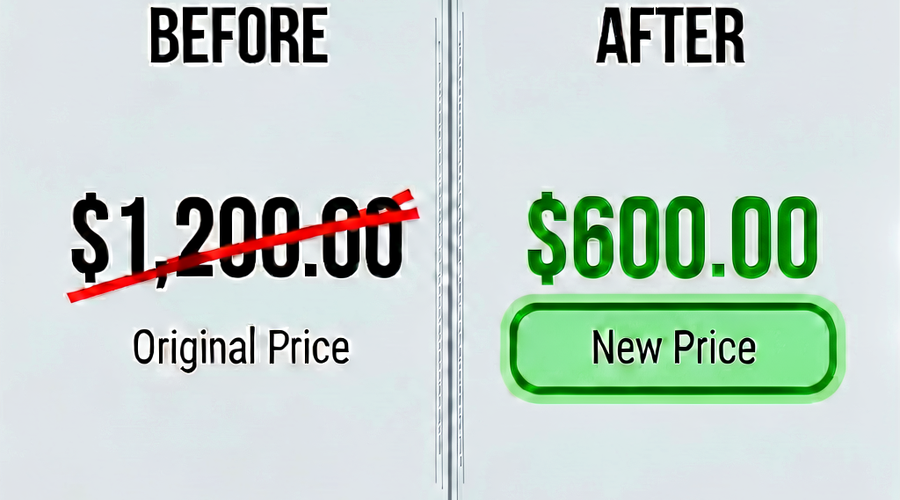
When you are comparing multiple deals or juggling stacked discounts, mental arithmetic can get messy. Use our percentage calculator to check any discount in seconds — enter the original price and the discount percentage, and it will tell you exactly what you pay and what you save.
Related reading
-
How to Work Out Percentages Without a Calculator
Master mental math strategies for working out percentages without a calculator — from the 10% building-block method to fraction shortcuts and estimation tricks.
-
How to Calculate Percentage: Formula, Examples, and Shortcuts
Learn how to calculate percentage with the core formula, step-by-step examples, and mental-math shortcuts you can use anywhere.
-
What Percentage Is X of Y? The Simple Formula Explained
Learn the one formula that answers 'what percentage is X of Y?' — with worked examples, a reference table, and tips for getting it right every time.